Versioning Machine Learning models: architecture, practices, and common pitfalls
- Edwin Kuss
- 10 min
Table of contents
- Why versioning Machine Learning models matters in 2026
- What does “Versioning machine learning models” actually mean?
- Machine Learning model versioning in practice: what teams usually miss
- Common mistakes in versioning prompts and models
- Platforms for ML model versioning: what to look for
- ML models versioning across the full ML lifecycle
- How to get started without overengineering
- Final thoughts
Machine learning systems rarely stand still. Models are retrained, datasets evolve, features change, and—increasingly—prompts and configurations are adjusted independently of model weights. In this environment, versioning machine learning models is no longer just a best practice; it is a foundational requirement for building reliable, reproducible, and scalable ML systems.
This article explores how machine learning model versioning works in practice, what teams often get wrong, how modern platforms approach the problem, and why proper versioning has become critical in the era of production ML and large language models.
Why versioning Machine Learning models matters in 2026
As ML systems move from experimentation to production, the cost of ambiguity grows. Teams need to answer questions such as: Which model version is running in production? What data was it trained on? Why does it behave differently from last month’s release?
Industry research consistently shows that lifecycle management is a major bottleneck for AI adoption. Gartner reports that up to 85% of AI projects fail to deliver expected business value, often due to weak governance, poor reproducibility, and a lack of operational discipline. Similarly, McKinsey’s global AI surveys indicate that organizations with mature ML lifecycle practices deploy models two to three times faster than those without them.
At the core of this maturity lies versioning. Without it, teams cannot reliably debug failures, reproduce results, or safely evolve models over time.
What does “Versioning machine learning models” actually mean?
Versioning machine learning models goes far beyond assigning version numbers to trained artifacts. It is about capturing the full training and execution context that defines a model’s behavior.
Model versioning vs. experiment tracking vs. artifact storage
These concepts are often conflated but serve different purposes:
- Experiment tracking records what happened during training runs — parameters, metrics, and intermediate results — to help teams compare experiments and understand why one run performed better than another.
➡️ Example: an ML engineer compares two training runs with different learning rates and sees that accuracy improved, but experiment tracking alone does not guarantee that the same result can be reproduced months later.
- Artifact storage stores binary outputs, such as model weights, checkpoints, or exported models, so they can be reused or deployed.
➡️ Example: a trained model file is uploaded to object storage and later loaded by a deployment pipeline, but without context about the dataset, code, or environment that produced it.
- Model versioning establishes immutable, traceable versions that link model artifacts with their training code, data, configuration, and evaluation results, enabling safe deployment, auditing, and rollback.
➡️ Example: when a production model starts underperforming, the team can roll back to a previous version and clearly see which dataset, hyperparameters, and prompt configuration were used to train it.
Effective versioning connects all three.
What needs to be versioned in modern ML systems
In modern pipelines, multiple components influence outcomes. Failing to version any of them can break reproducibility.
| Component | What is versioned | Why it matters |
| Model weights | Serialized model artifacts | Enables rollback and comparison |
| Training code | Source code and configuration | Allows identical retraining |
| Datasets | Dataset versions or snapshots | Prevents silent data drift |
| Hyperparameters | Learning rate, architecture choices | Explains performance differences |
| Environment | Libraries, frameworks, hardware | Eliminates environment mismatch |
| Evaluation metrics | Accuracy, loss, custom metrics | Supports objective validation |
| Prompts (LLMs) | Prompt text and templates | Tracks behavioral changes |
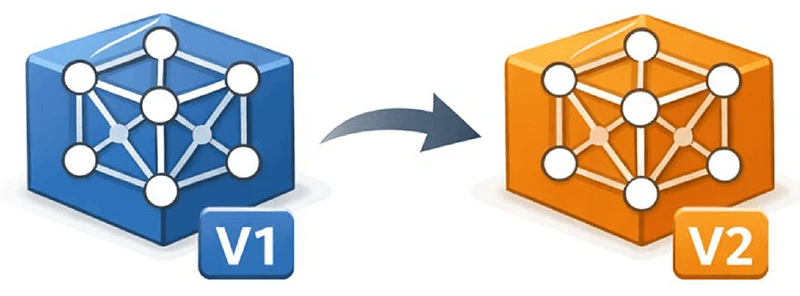
This holistic view defines effective ML model versioning.
Machine Learning model versioning in practice: what teams usually miss
Despite widespread awareness, many teams still struggle to implement machine learning model versioning correctly.
Versioning models without data lineage
A model trained on slightly different data is, in practice, a different model. Without dataset versioning or snapshots, retraining becomes guesswork, and debugging model drift is nearly impossible.
Ignoring environment and dependency versions
Framework updates, CUDA versions, or minor library changes can significantly alter training behavior. Teams that do not capture the environment context often find that “retraining the same model” produces different results.
Treating versioning as a one-time task
Versioning is not limited to deployment. It must span experimentation, validation, production releases, and post-incident analysis. Otherwise, gaps appear exactly when traceability is most needed.
Common mistakes in versioning prompts and models
Modern ML systems — especially those built around LLMs — introduce new failure modes that traditional versioning practices do not cover. The following examples are among the most common mistakes in versioning prompts and models, and they often surface only after systems reach production.
Not versioning prompts at all
Prompts encode business logic, constraints, and behavioral assumptions, even though they are often stored as plain text. A small wording change — such as adjusting instructions, examples, or system messages—can alter outputs as dramatically as retraining a model with new data.
In practice, teams that do not version prompts lose the ability to explain why model behavior changed between releases or to reproduce results during debugging, audits, or incident reviews.
Mixing prompt and model versions
Prompts and models typically evolve on different timelines: prompts may be refined daily, while models are retrained weekly or monthly. When prompt changes are implicitly tied to model versions, it becomes difficult to determine whether a performance change is due to new weights or updated instructions.
This tight coupling hides the true source of change and slows down troubleshooting. More robust systems version prompts and models independently while linking them through metadata and lineage.
Overwriting working versions instead of creating immutable ones
Overwriting a “working” model or prompt may seem efficient, but it permanently removes historical context. Once a version is mutated, teams can no longer perform accurate rollbacks, compare behavior across releases, or reconstruct past decisions.
Immutable versions preserve history and enable reliable post-mortems, compliance checks, and long-term performance analysis — especially in regulated or enterprise environments.
These mistakes explain why many ML systems fail, not because of model quality, but because of poor lifecycle control.
Platforms for ML model versioning: what to look for
As ML systems scale, ad-hoc scripts and manual processes no longer suffice. This is where platforms for ML model versioning play a key role.
Core capabilities modern platforms should provide
At a minimum, platforms should support:
- Immutable model versions
- Dataset and experiment lineage
- Metadata and tagging
- Model comparison and rollback
- Access control and ownership tracking
Why Git alone is not enough for ML model versioning
Git excels at code versioning, but ML introduces challenges Git was not designed for: large binaries, complex metadata, experiment context, and runtime environments. As a result, Git often becomes only one component of a broader versioning strategy.
How modern MLOps platforms approach model versioning
Modern MLOps platforms combine experiment tracking, dataset lineage, and model registries into a single workflow. Platforms such as Kiroframe follow this integrated approach by linking model versions with training context, datasets, and evaluation results, helping teams maintain reproducibility across experimentation and production stages.
This reduces the risk of deploying models without clear lineage or ownership.
ML models versioning across the full ML lifecycle
Effective ML model versioning spans the entire lifecycle, not just deployment.
Versioning during experimentation
Early-stage experimentation requires fast iteration, parallel branches, and comparison across many candidates. Versioning enables teams to explore aggressively without losing traceability.
Versioning during validation and approval
As models move closer to production, versioning supports formal evaluation, review, and approval processes. Clear lineage makes it possible to justify why a specific version was selected.
Versioning in production and monitoring
In production, version identifiers become operational tools. They allow teams to:
- correlate incidents with specific versions
- roll back safely
- analyze long-term performance trends
How to get started without overengineering
Adopting versioning does not require enterprise-scale tooling from day one.
Define what “a version” means for your team
Agree on what constitutes a new version: data changes, parameter changes, prompt updates, or environment shifts.
Automate versioning early
Integrate version capture into training pipelines and CI/CD workflows. Automation prevents human error and ensures consistency.
Choose tooling that grows with ML maturity
Start simple, but avoid solutions that cannot scale. Versioning practices should evolve alongside model complexity and organizational needs.
Final thoughts
Versioning machine learning models is not about bureaucracy or slowing teams down. It is about enabling speed with confidence. In modern ML systems — especially those built on retraining loops and prompt-driven behavior — versioning forms the backbone of reliability, governance, and scalability.
Teams that invest early in clear versioning practices spend less time debugging, recover faster from failures, and deploy models with far greater trust. In today’s ML landscape, the question is no longer whether to version models, but how well your versioning strategy supports the systems you are building.