
AI model comparison: how businesses choose the right AI engine
- Edwin Kuss
- 10 min
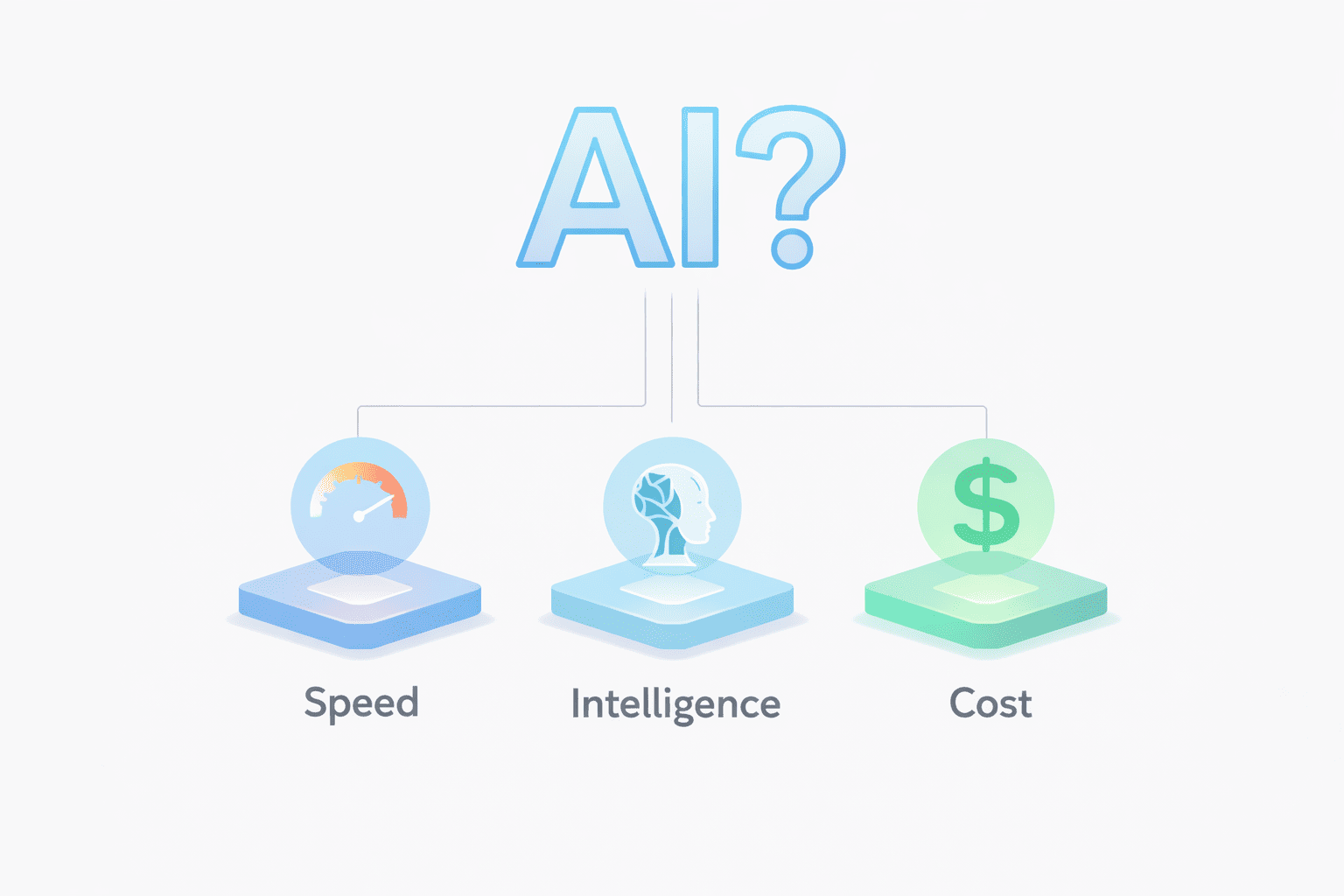
Table of contents
- Why choosing an AI model is a business decision, not just a technical one
- The AI model selection matrix: key criteria businesses should evaluate
- Comparing AI model types using real business scenarios
- AI model comparison by approach: open-source, proprietary, and hybrid
- Common mistakes companies make during AI model selection
- A simple step-by-step framework for choosing the right AI model
- Why AI model choice becomes harder at scale
- Conclusion
The rapid growth of artificial intelligence has given businesses access to a wide range of AI models, platforms, and services. According to recent adoption data, 78% of organizations worldwide now use AI in at least one business function, a significant increase from just 55 % a year earlier, showing how quickly AI has moved from niche exploration to core operations.
At the same time, studies show that over 90% of companies are using or actively exploring AI technologies, and many organizations plan to increase investment as they scale experimentation into production.
From large language systems to forecasting engines and computer vision tools, companies today face an abundance of choice. Yet this abundance can create confusion: how do you decide which option actually fits your business needs?
Choosing an AI model is no longer just a technical decision made by data scientists. It is a strategic business choice that affects cost, scalability, risk, and long-term sustainability. This article provides a practical AI model comparison framework to help companies understand how to choose an AI model, what criteria matter most, and how to approach AI model selection in real business scenarios.
Why choosing an AI model is a business decision, not just a technical one
Why performance alone is not enough
AI benchmarks and technical performance metrics can be misleading when taken out of context. A model that performs exceptionally well in controlled tests may fail to deliver value in real-world conditions due to latency, cost, or integration complexity. For most businesses, reliability, predictability, and operational fit matter just as much as raw intelligence.
In practice, the “best” model on paper is not always the best model in production. Companies need solutions that align with their workflows, budgets, and users — not just impressive demo results.
The hidden cost of a wrong AI model choice
Choosing the wrong AI model can introduce long-term costs that are difficult to reverse. These include rising operational expenses, engineering rework, performance bottlenecks, and reduced trust from internal teams or customers. In some cases, organizations are forced to rebuild entire systems because early model decisions did not scale or meet compliance requirements.
This is why AI model selection should start with business context, not technology preference.
The AI model selection matrix: key criteria businesses should evaluate
A structured comparison helps companies understand how to choose an AI model that aligns with their business goals and operational constraints. Below are the most important criteria organizations should evaluate before making a decision.
Speed and latency
Speed is critical for user-facing applications such as chatbots, assistants, and real-time recommendations. Slow responses can degrade user experience and reduce adoption. In contrast, internal analytics or batch processing systems may tolerate higher latency without business impact.
Understanding whether your use case requires real-time or delayed responses is essential when selecting an AI engine.
Intelligence and reasoning depth
Not all tasks require advanced reasoning or complex decision-making. Simple classification, tagging, or anomaly detection often performs better with lighter models that are easier to maintain. Over-engineering intelligence can increase costs and complexity without delivering proportional business value.
The goal is to match the model’s capabilities to the problem, not to maximize sophistication.
Cost and pricing model
Cost structures vary significantly between AI approaches. Some models rely on usage-based pricing, while others require upfront infrastructure investment. Businesses must consider not only current usage, but also how costs will scale as adoption grows.
Predictable cost models are often more valuable than lower initial prices, especially for long-term deployments.
Scalability and workload patterns
AI workloads vary with demand. Some applications experience steady usage, while others see unpredictable spikes. Models that scale well under variable load help prevent performance issues and cost overruns.
Understanding workload patterns early helps avoid surprises after deployment.
Data sensitivity and compliance
Data privacy and regulatory requirements play a significant role in AI model selection. Industries such as finance, healthcare, and government often need full control over data storage, access, and processing. In these environments, deployment options and auditability can outweigh convenience.
Ignoring compliance early can limit future growth or force costly redesigns.
Customization and fine-tuning
Some businesses require models that understand domain-specific language, workflows, or data structures. Customization and fine-tuning improve accuracy and relevance but also introduce operational overhead.
The decision depends on how unique your requirements are compared to general-purpose use cases.
Comparing AI model types using real business scenarios
Customer-facing applications
For chatbots, virtual assistants, and support automation, responsiveness and user experience are critical. A retail company, for example, may deploy an AI-powered chat assistant on its website to answer delivery questions, process returns, or recommend products. In such scenarios, users expect instant responses, and even minor delays can lead to frustration or abandoned sessions.
Because speed and reliability matter more than deep customization at this stage, many companies choose managed or proprietary AI systems that integrate quickly and scale without significant operational effort. The primary goal in customer-facing use cases is to deliver value quickly, validate the experience, and maintain consistent performance under fluctuating traffic — especially during peak periods such as sales campaigns or seasonal demand.
Internal analytics and decision support
Forecasting, optimization, and reporting systems typically operate behind the scenes, supporting business teams rather than end users. For example, a manufacturing company may use AI-driven forecasting systems to predict demand and optimize inventory levels across warehouses. A finance team may rely on predictive models to assess cash flow scenarios or identify cost anomalies.
In these cases, cost predictability, explainability, and integration with internal data sources are more important than instant responses. Businesses often prefer controlled environments where models can be tailored to internal data, monitored over time, and adjusted as assumptions change. Here, long-term efficiency, transparency, and trust in the outputs matter more than speed-to-market.
Regulated or sensitive environments
Organizations working with sensitive or regulated data — such as banks, healthcare providers, or government agencies — must prioritize data control, auditability, and compliance above all else. For instance, a financial institution using AI for fraud detection or credit risk assessment must ensure that all data processing complies with regulatory requirements and can be audited as needed.
In these environments, AI systems are often deployed in private or tightly controlled infrastructures with strict access policies. Although this approach requires more operational effort, it significantly reduces legal and reputational risk. The need for transparency, governance, and long-term regulatory compliance justifies the additional complexity.
These real-world scenarios illustrate why AI model selection is always context-driven: the same company may use different AI approaches for customer interactions, internal planning, and regulated workloads — each optimized for a different set of priorities.
The table below summarizes how different business contexts influence AI model choice, helping teams quickly understand which approach typically fits each scenario.
Business scenario | Primary priorities | Typical AI approach | Why this approach fits |
Customer-facing applications (chatbots, virtual assistants, support automation) | Speed, low latency, user experience, fast deployment | Proprietary or managed AI systems | These systems allow rapid launch, consistent performance, and minimal operational overhead, which is critical for user-facing features |
Internal analytics and decision support (forecasting, optimization, reporting) | Cost predictability, explainability, and integration with internal data | Open-source or self-hosted AI systems | Greater control and transparency make it easier to tailor models, manage costs at scale, and align with internal workflows |
Regulated or sensitive environments (finance, healthcare, government) | Data control, compliance, auditability, governance | Open-source or private AI deployments | Full control over data and infrastructure supports regulatory requirements and reduces compliance and security risks |
AI model comparison by approach: open-source, proprietary, and hybrid
When proprietary AI models make sense
Proprietary AI systems are often the fastest way to launch AI-powered features. They require minimal infrastructure management and allow teams to focus on product development rather than model operations. This makes them attractive for startups, pilots, and customer-facing applications.
However, usage-based pricing and limited transparency can become challenges as scale increases.
When open-source AI models are a better fit
Open-source AI systems provide greater control over data, customization, and deployment. They are often preferred by enterprises that need predictable costs, on-premises deployment, or compliance flexibility. While they require more engineering effort, they can offer long-term efficiency at scale.
The trade-off is higher operational responsibility.
Why hybrid AI strategies are becoming the default
Many organizations combine both approaches. Proprietary AI may be used for experimentation or external interactions, while open-source systems support internal or sensitive workloads. Hybrid strategies reduce vendor lock-in and allow businesses to optimize for different priorities across use cases.
Common mistakes companies make during AI model selection
Optimizing for intelligence instead of business value
More advanced models are not always better. Many projects fail because they prioritize technical sophistication over measurable outcomes. Simpler solutions often deliver faster and more reliable results.
Ignoring long-term cost and scaling impact
Early cost estimates rarely reflect production realities. As usage grows, pricing models and infrastructure demands can change dramatically. Planning for scale from the start helps avoid painful adjustments later.
Underestimating operational complexity
AI systems require monitoring, retraining, and governance. Without proper planning, maintenance becomes a bottleneck that slows innovation.
Choosing a model before defining success metrics
Without clear success criteria, it is impossible to evaluate whether an AI initiative is working. Metrics should be defined before models are selected, not after deployment.
A simple step-by-step framework for choosing the right AI model
Understanding how to choose the right AI model starts with a structured approach that connects technical decisions to business outcomes. Instead of selecting a model based on popularity or raw performance, companies benefit from breaking the decision down into a precise sequence of practical steps. This framework helps teams understand how to choose an AI model that aligns with their goals, constraints, and long-term plans.
Step 1 — Define the business goal
Clearly identify the problem you want to solve and the outcome you expect to achieve. Whether the goal is to reduce operational costs, improve response times, or increase forecast accuracy, success criteria should be defined before evaluating any AI solution.
Step 2 — Understand workload and users
Determine who will use the system, how frequently it will be used, and under what conditions. User-facing applications, internal analytics, and background automation often place very different demands on speed, reliability, and scalability.
Step 3 — Set cost and risk boundaries
Establish acceptable cost ranges, data sensitivity requirements, and compliance constraints upfront. This step prevents teams from considering options that may appear technically attractive but are not viable from a business or regulatory perspective.
Step 4 — Shortlist and test models
Create a short list of candidate solutions and test them using realistic data and scenarios. Comparing models under conditions that mirror real-world usage is one of the most effective ways to validate assumptions and avoid costly surprises later.
Step 5 — Plan for production and scale
Think beyond initial deployment and consider how the system will be monitored, maintained, and scaled over time. Planning for governance, performance tracking, and long-term sustainability ensures that early success can be repeated as adoption grows.
By following this framework, organizations can clearly understand how to choose the right AI model for their business and turn AI model selection into a repeatable, low-risk decision process rather than a one-time experiment.
Why AI model choice becomes harder at scale
As organizations grow, they often deploy multiple AI systems across teams and departments. Managing performance, cost, and consistency becomes increasingly complex. Without clear visibility and coordination, AI initiatives can fragment and lose efficiency.
This is why AI model selection is not a one-time task, but an ongoing process that evolves alongside the business.
Conclusion
There is no universal answer on how to choose an AI model. The right choice depends on business goals, operational constraints, cost expectations, and risk tolerance. A thoughtful AI model comparison grounded in real-world criteria helps companies avoid hype-driven decisions and focus on sustainable value.
Organizations that succeed with AI treat AI model selection as a strategic capability — aligning technology choices with long-term business needs and planning for growth from the start.